Lecture 14: PCA — Dimensionality Reduction

MSE 125 — Applied Statistics

Madeleine Udell

Wednesday, May 13, 2026

logistics

  • project midterm report due Friday May 15
  • HW 4 out later this week — trees + PCA + clustering + Kaggle challenge

the brief

risk analyst, $5B asset manager

your book: S&P 100 stocks.

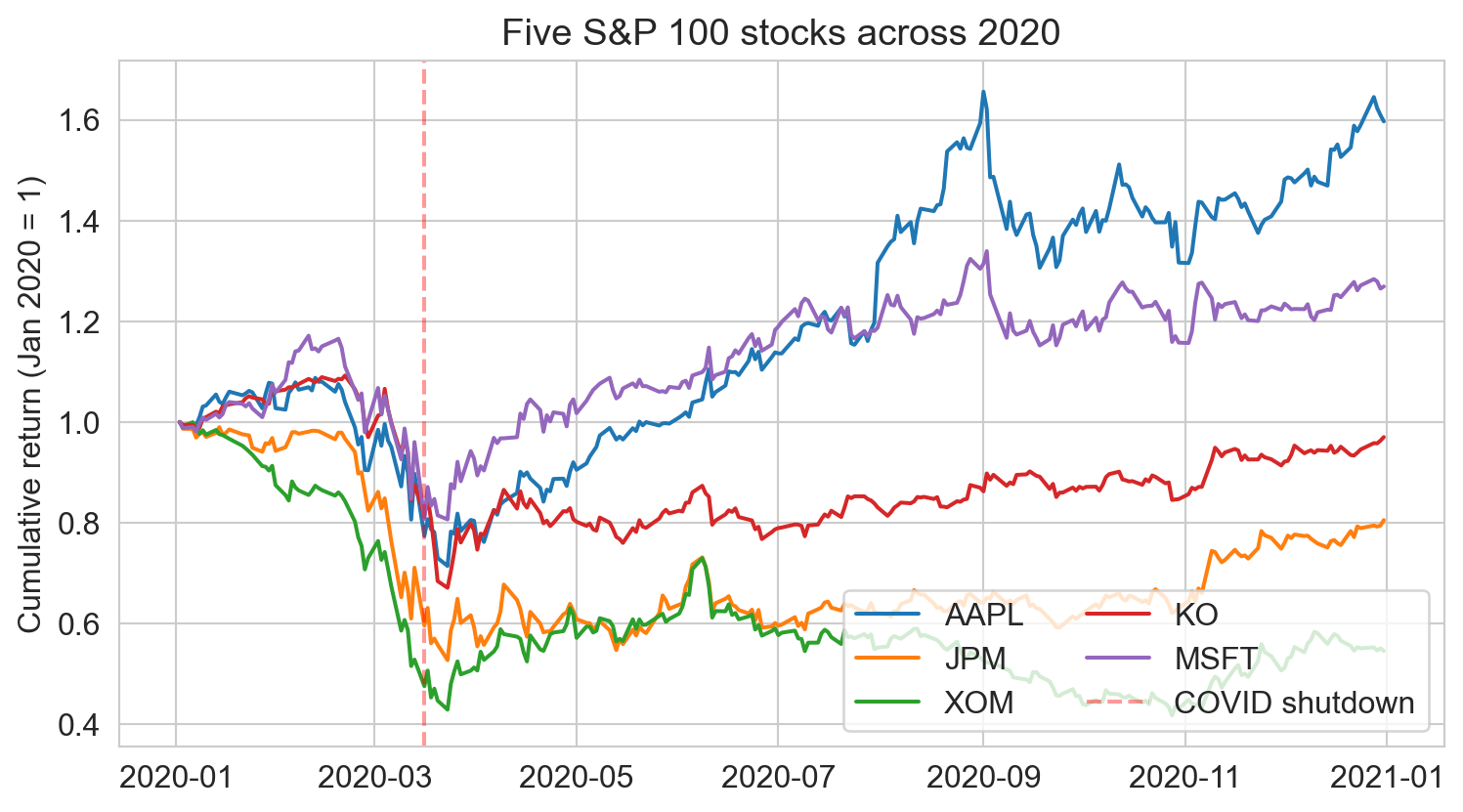
last March: every name crashed together

CIO asks: what risk are we really exposed to?
today

  • the picture — geometry of the best line, then the best subspace
  • reading the components — what PC1 / PC2 / PC3 mean for the S&P 100
  • the payoff — minimum-variance portfolios in the p > n regime

bridge from supervised learning

regression / classification PCA
input features X + label y features X only
goal predict y from X summarize X in k \ll p dims
evaluation held-out prediction error (today: held-out portfolio variance)
family supervised unsupervised

no y, no “right answer”. the algorithm finds structure on its own.

the picture: best line, best subspace

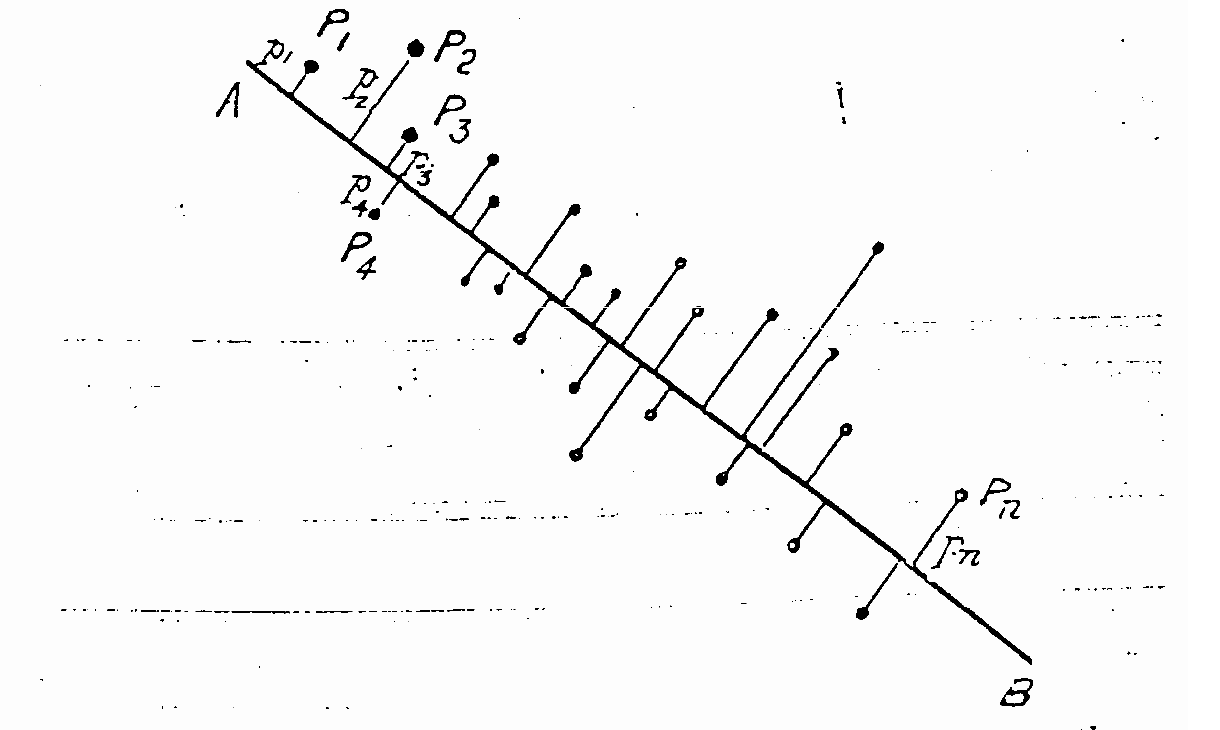
Pearson 1901 — same picture, drawn before computers

Pearson, Phil. Mag. 1901

given a cloud of points, what line minimizes the sum of squared perpendicular distances from points to the line?

Pearson answered this in any number of dimensions

just elementary geometry

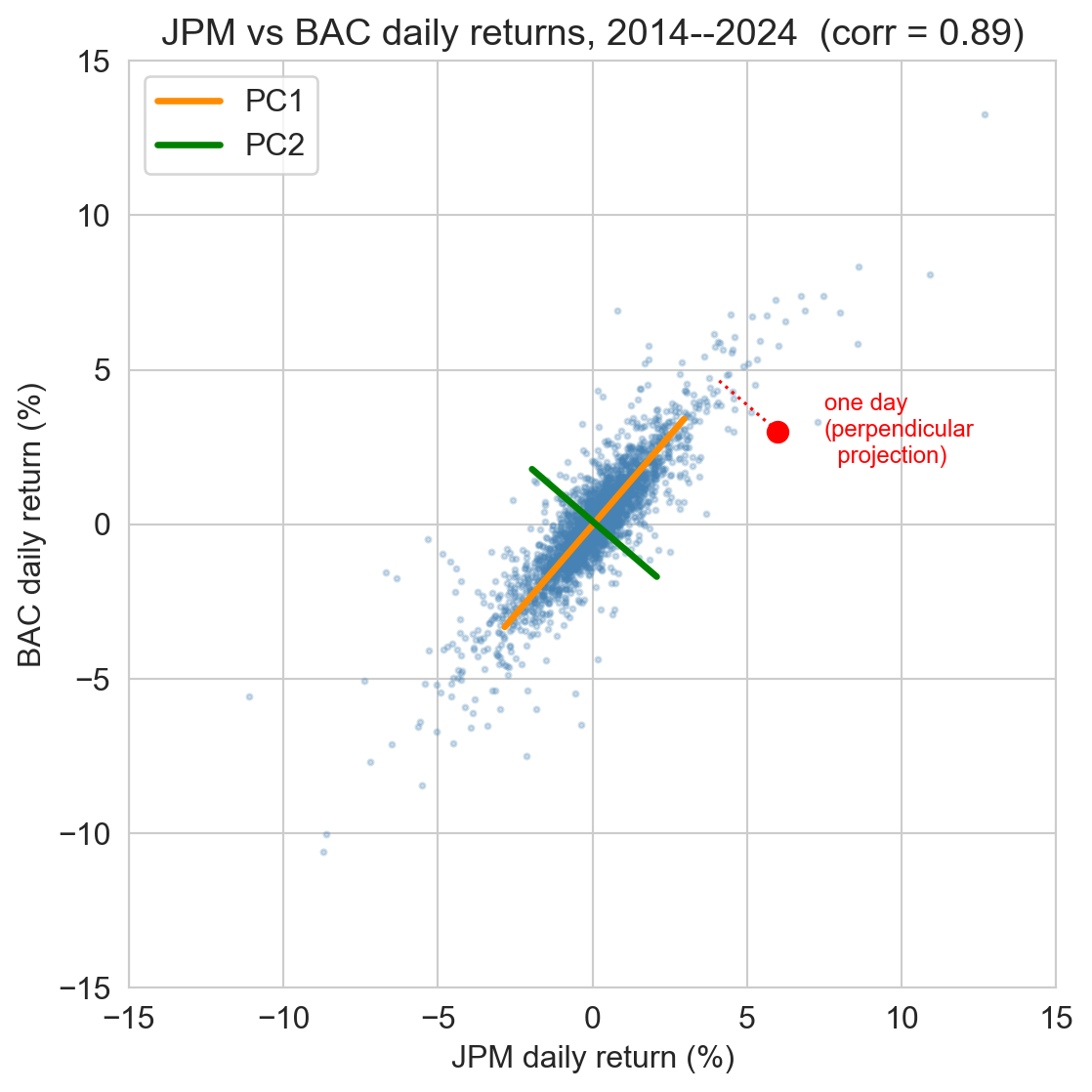
same picture, real data — JPMorgan vs Bank of America

PC1 by hand — two stocks, a few lines

# 2x2 covariance, then top eigenvector (sorted largest first)
C = np.cov(jpm_centered, bac_centered, ddof=1)
eigvals, eigvecs = np.linalg.eigh(C)
order = np.argsort(eigvals)[::-1]
v1 = eigvecs[:, order[0]]                  # PC1 direction

# project the example day onto PC1
score = (np.array([6.0, 3.0]) - mean_xy) @ v1
PC1 direction       : (+0.653, +0.757)
PC1 variance share  : 94.4%
PC2 variance share  :  5.6%
Example day score on PC1: +6.12

scaling up — 95 stocks, same problem

returns = pd.read_csv('sp100_daily_returns_2014_2024.csv',
                      index_col=0, parse_dates=True)
print(returns.shape)
(2770, 95)

the data matrix X has shape n \times p   —   rows = 2770 days, columns = 95 stocks

now what? in 2D we drew a picture. in 95D we run the same eigendecomposition (or its rectangular cousin, the SVD — coming up).

predict before we run it.

we run PCA on the 95 stocks without standardizing (raw returns).

which stocks dominate PC1?

    1. the largest companies (Apple, Microsoft, Berkshire)
    1. the most volatile stocks (Tesla, semiconductors)
    1. the financials (banks, insurance)
    1. PC1 will be roughly equal across all 95

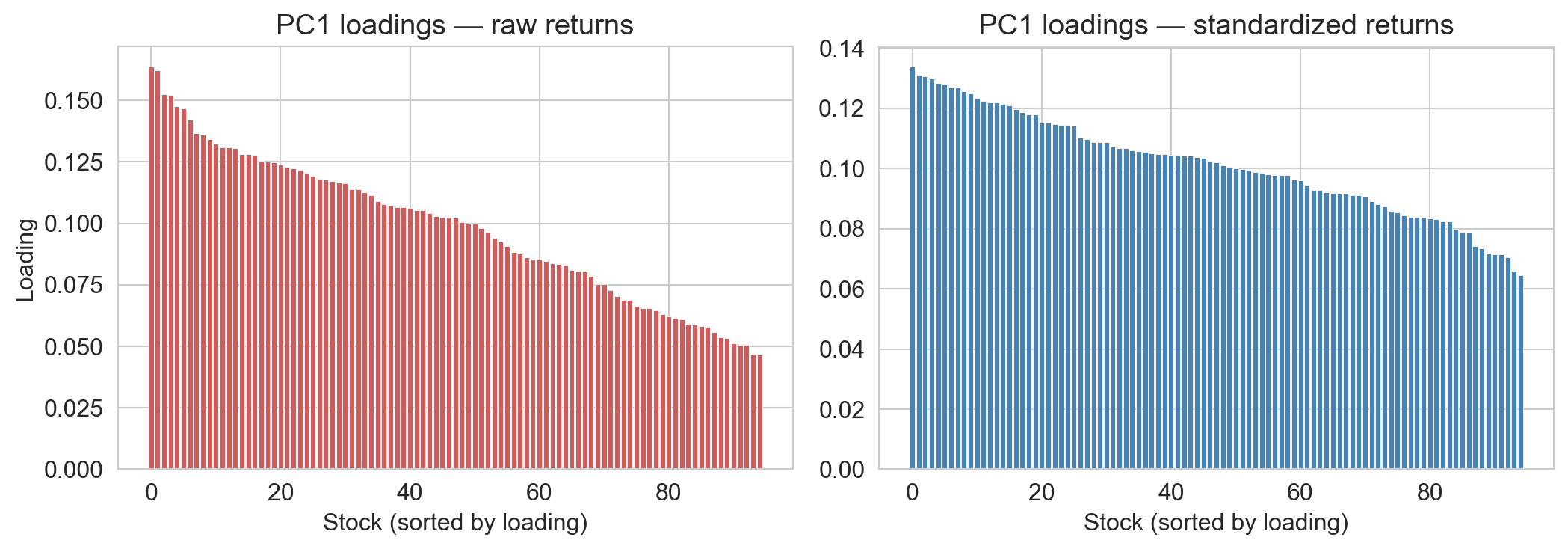
without standardization — high-vol stocks dominate

top 5 by |PC1 loading|

raw standardized
AMD 0.164 BLK 0.134
NVDA 0.162 HON 0.131
COF 0.153 MS 0.131
TSLA 0.152 JPM 0.130
BA 0.148 C 0.128

raw: semis, EV, aerospace — the loud names, top 5 hold ~12%

standardized: financials — the most market-correlated, top 5 hold ~8.5% (baseline 5.3%)

the fix — standardize before PCA

standardization (z-score)

subtract each feature’s mean, divide by its standard deviation

z_{ij} = \frac{x_{ij} - \mu_j}{\sigma_j}

after standardization, every column has mean 0 and variance 1

→ PCA finds structure in the correlations, not the raw magnitudes

→ for returns, this is almost always what we want

reading the components

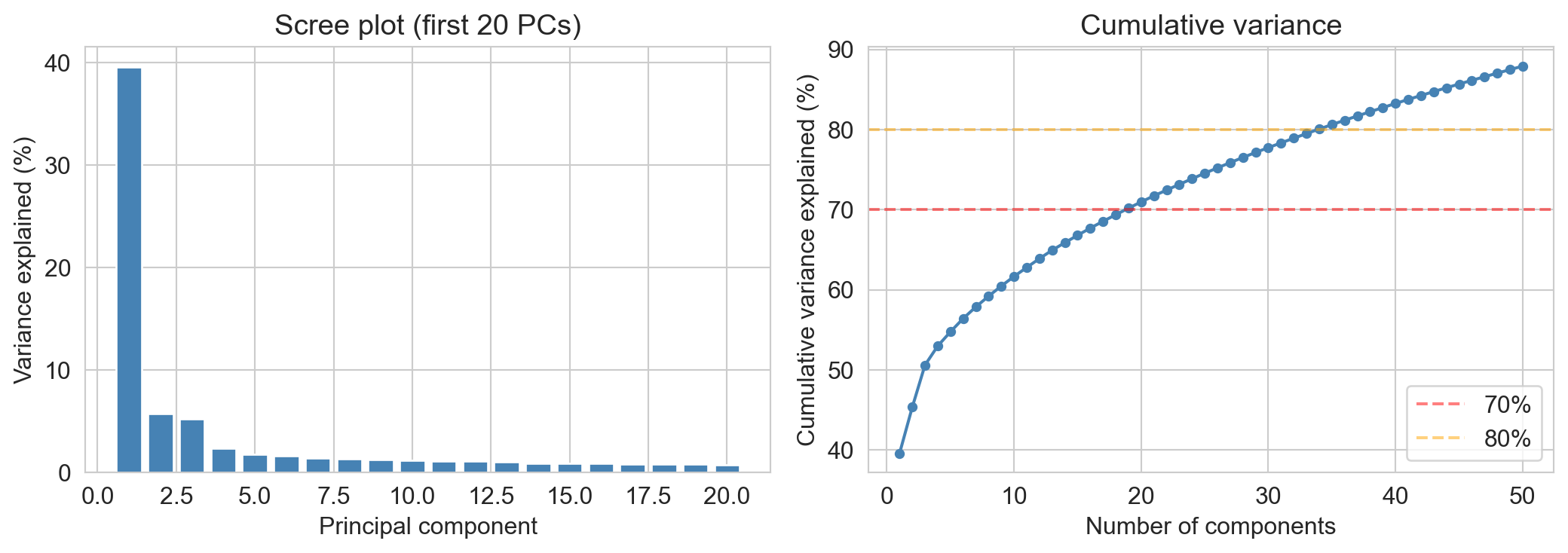
the scree plot — variance per PC

  • PC1 alone: ~40% of variance
  • 70% needs ~20 PCs; 80% needs ~35
  • one big factor + a long flat tail — typical of equity returns

elbow method — a heuristic, not a formula

elbow method

choose k where the scree bars stop dropping quickly — the bend in the plot

  • before the elbow: meaningful structure
  • after the elbow: noise

Warning

the elbow can mislead. on real data, even a sharp elbow may not pick the k that wins on a downstream task.

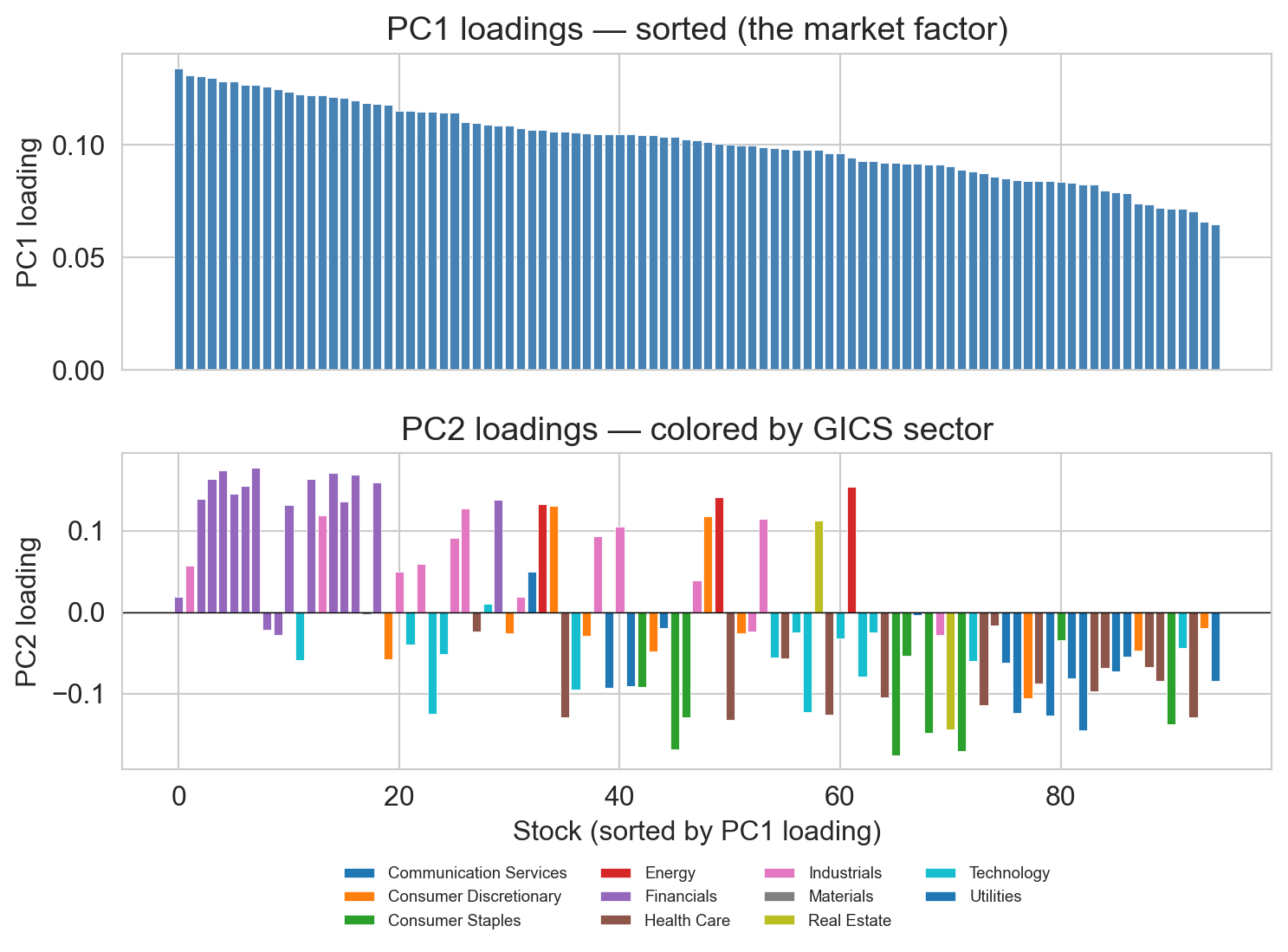
interpret PC1 — the market factor

top: every stock loads positively → PC1 is the common up-down move

bottom (PC2, sectors): financials + energy on top; staples + utilities on bottom

PC2 = cyclicals vs defensives

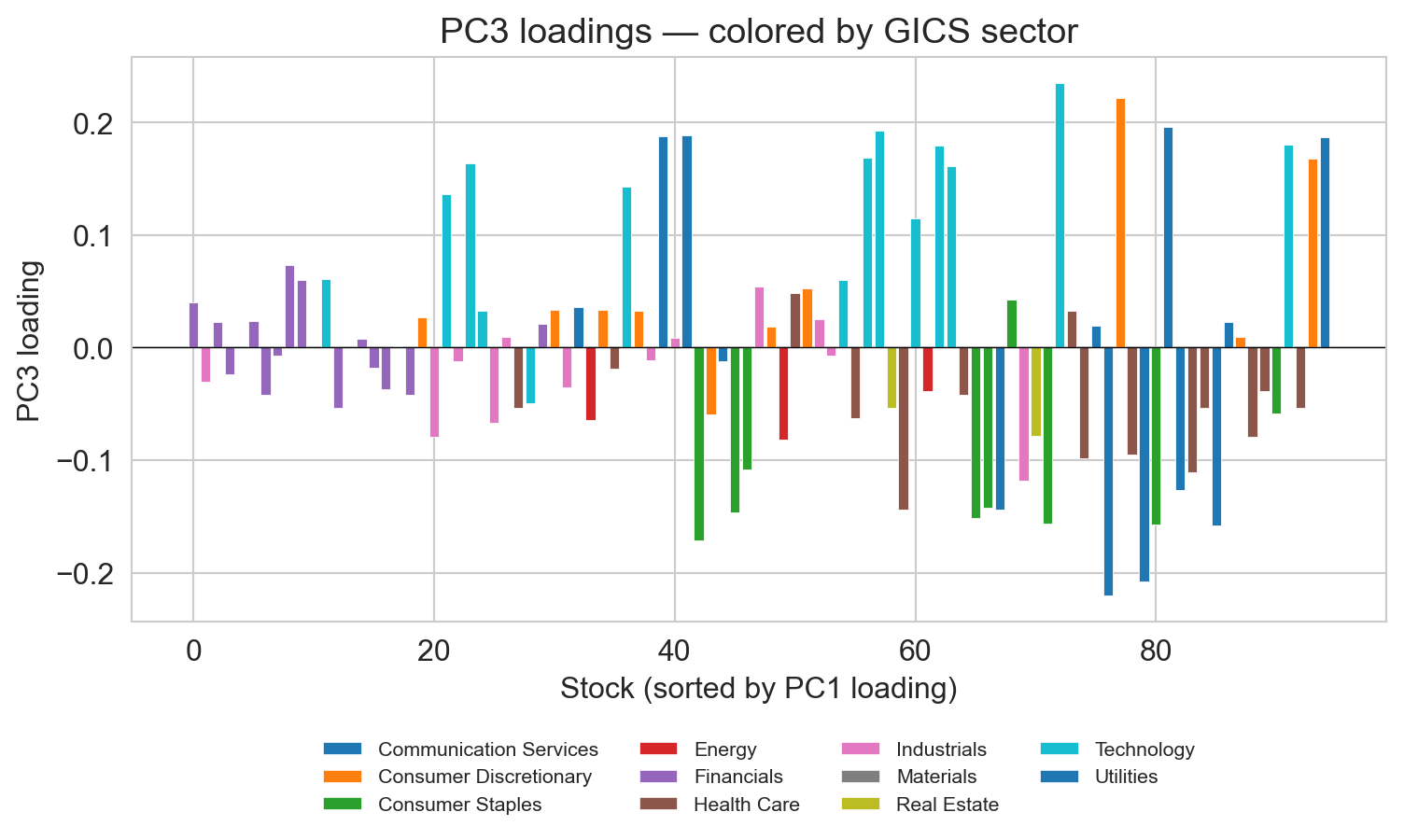
interpret PC3 — growth vs yield

positive: NVDA, AMZN, META, GOOGL, ADBE — growth tech

negative: utilities (DUK, SO), staples (KO), high-dividend telecom (VZ) — yield

by PC5 or PC6, the economic story runs out

we have named factors. did PCA work?

PC1 looks like the market. PC2 splits cyclicals from defensives. PC3 splits growth from yield.

have we proved PCA worked on the S&P 100?

discuss with your neighbor (3 min).

the math — what is PCA solving?

PCA (variational form)

among all k-dimensional subspaces of \mathbb{R}^p, PCA picks the one closest to the data:

S^\star = \arg\min_{\dim S = k}\; \sum_{i=1}^n \|x_i - P_S x_i\|^2

equivalently (by Pythagoras, after centering): the subspace that maximizes the total variance of the projections

with k=1: the best line through the cloud (Pearson’s picture)

with k=2: the best plane. with k general: the best k-dim subspace.

the math — how do we solve it?

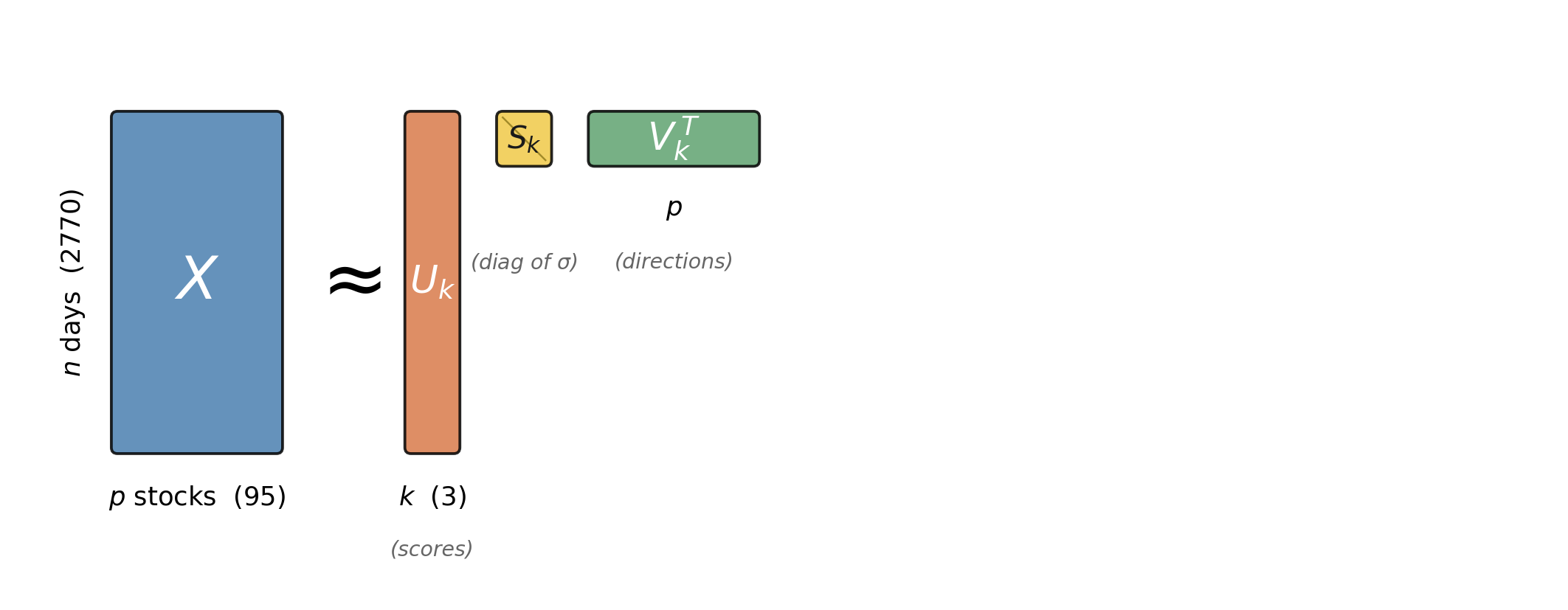
data matrix X \in \mathbb{R}^{n \times p}   —   row i = x_i

  • 2 stocks (earlier): eigendecomposed the 2 \times 2 covariance
  • general X: truncated SVD   X \approx U_k S_k V_k^T   (works directly on X — no covariance to form)

what each piece means

symbol size meaning
V_k p \times k principal directions — basis for S^\star
U_k S_k n \times k projected scores — each row = one day’s coordinates
\Lambda_k = S_k^2/(n{-}1) k \times k PC variances

→ truncated SVD = best rank-k approximation to X in Frobenius error (Eckart–Young–Mirsky)

verify — PCA() is the truncated SVD

U, S_svd, Vt_svd = np.linalg.svd(Z, full_matrices=False)

# Match up to a sign per component (sign of a PC is arbitrary)
signs = np.sign((Vt_svd[:3] * pca.components_[:3]).sum(axis=1))
print("max difference in directions:",
      np.abs(Vt_svd[:3] * signs[:, None] - pca.components_[:3]).max())
print("max difference in variances:",
      np.abs(S_svd[:3]**2 / (n-1) - pca.explained_variance_[:3]).max())
max difference in directions: 1.4e-15
max difference in variances:  3.5e-17

PCA() and np.linalg.svd give the same answer to numerical precision

the payoff: portfolios in the p > n regime

why minimum variance? compounding

  • two portfolios with the same average return don’t earn the same dollars
  • a portfolio that loses 50% then gains 50% finishes down 25%, not flat
  • compounding punishes losses more than gains

→ cutting volatility while holding return constant grows real wealth over time

→ low-volatility ETFs and pension-fund mandates: this is exactly their target

full Markowitz problem trades off return and variance; we focus on variance because that’s where covariance estimation — and PCA — bites

minimum-variance portfolio — Markowitz 1952

minimize portfolio variance, subject to weights summing to 1:

\min_w \, w^T \Sigma w \quad \text{s.t.} \quad \mathbf{1}^T w = 1

closed form:    w_{\text{min-var}} \propto \Sigma^{-1} \mathbf{1}

read it qualitatively:

  • low-variance stocks get larger weights — less risk per dollar
  • natural hedges (negative covariances) get larger weights — cancel each other
  • volatile + correlated names get smaller weights — redundant risk

→ to use this, we need \Sigma — and to invert it

Markowitz, J. Finance 1952

the failure mode — p > n

60-day window with 95 stocks:   p = 95,   n = 60

sample covariance is rank-deficient

59 nonzero eigenvalues out of 95 → singular → inverse doesn’t exist

even with a tiny ridge (\lambda = 10^{-6}), the “min-variance” portfolio is unusable:

max single-stock weight +32%
min single-stock weight −29%
gross exposure (long + short) 809%
max weight change after shifting window 1 day 9% per stock

→ not investable — we need a structured estimate of \Sigma

PCA gives us \Sigma — the factor model

approximate \Sigma as k factors + diagonal noise:

\hat\Sigma_k = V_k \Lambda_k V_k^T + \mathrm{diag}(D)

  • V_k = top k PC directions (the factors)
  • \Lambda_k = diagonal of PC variances
  • \mathrm{diag}(D) = stock-specific residual — ensures \mathrm{diag}(\hat\Sigma_k) = 1 on standardized data

\hat\Sigma_k^{-1} exists, plugs cleanly into Markowitz

how big should k be? ask cross-validation

the four estimators

method formula role
equal-weight w = \mathbf{1}/p baseline (no covariance)
ridge sample \Sigma + \lambda I invertibility hack
random projection random V_k + diag correction sanity check
PCA factor top-k PC factors + diag correction the contender

we backtest with walk-forward evaluation — train on the past, hold for the next 21 days, slide

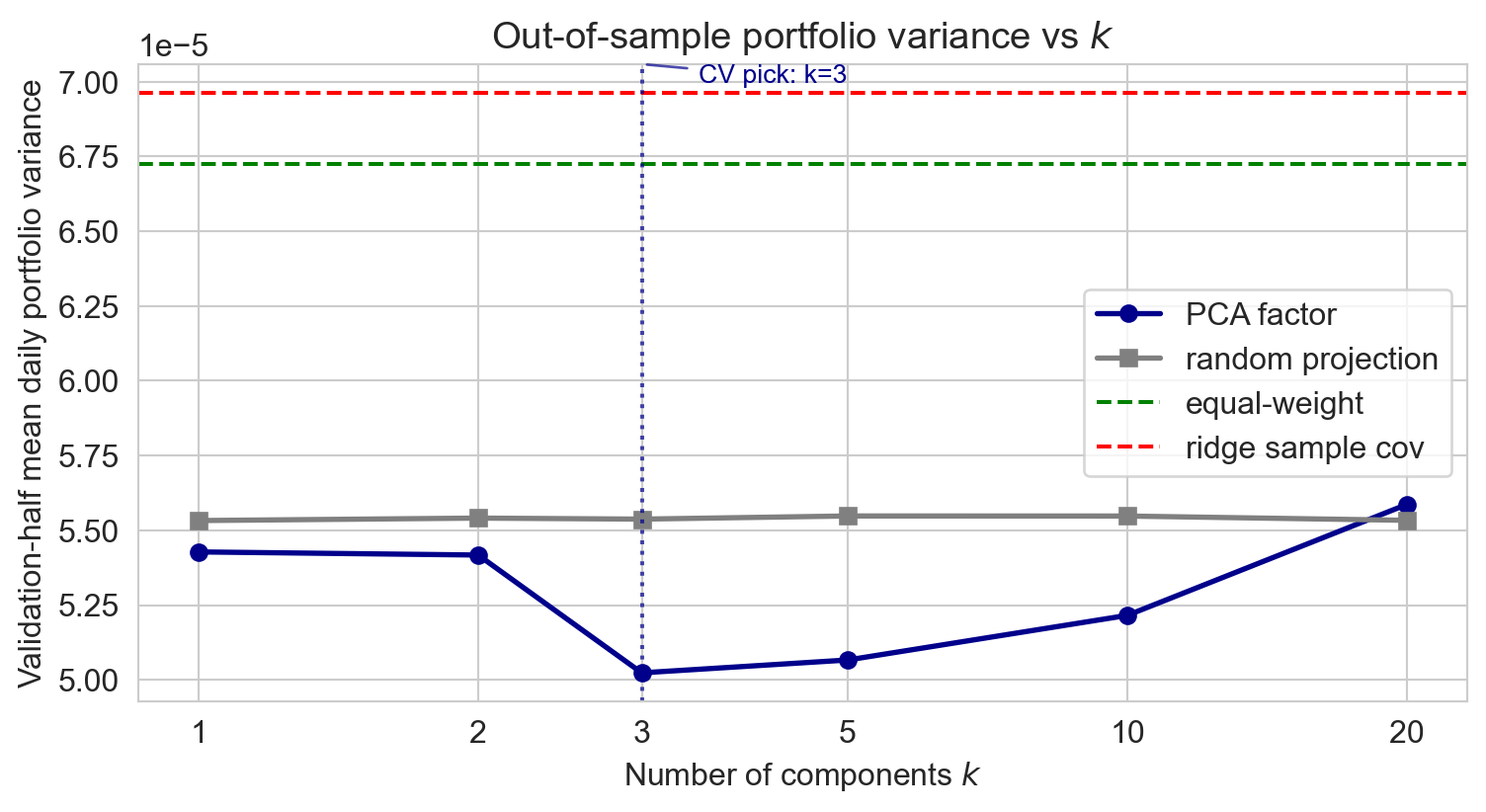
the result — variance vs k

  • PCA factor (blue) drops fast 1→3, flat-ish 3→10, rises past 10
  • CV picks k = 3 — well below scree’s “elbow at 1”
  • random projection (gray) lies above PCA throughout — variance-aligned directions matter

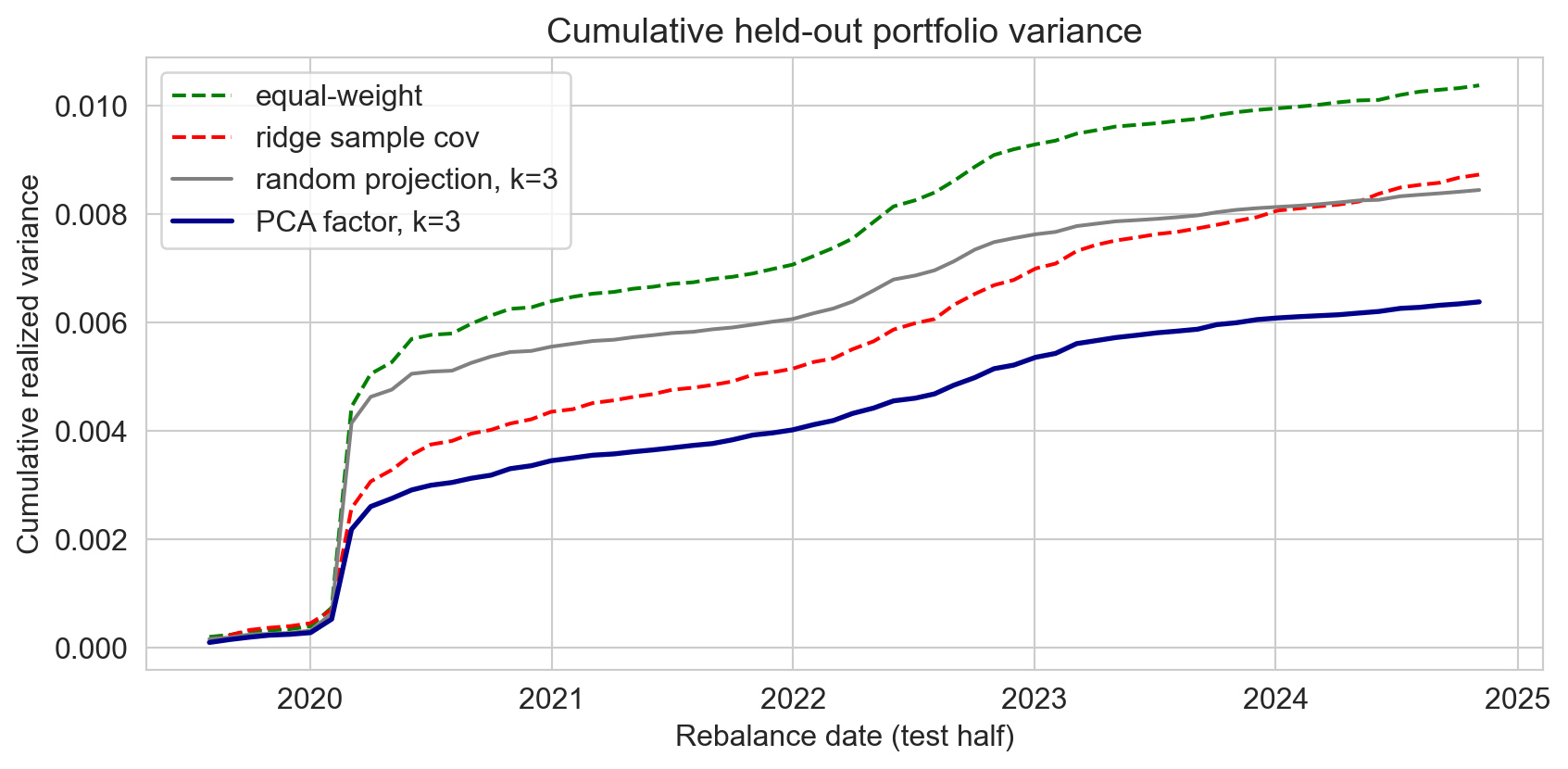
the result — cumulative variance over time

PCA factor portfolio sits lowest the entire test period

every method jumps at COVID; PCA’s jump is smallest

interpretability is not validation

PC1 = market,   PC2 = cyclicals / defensives,   PC3 = growth / yield

→ a clean story. but a story is not the test.

the test:   held-out portfolio variance, on data we never used to fit

→ pick the model that wins on the task you care about

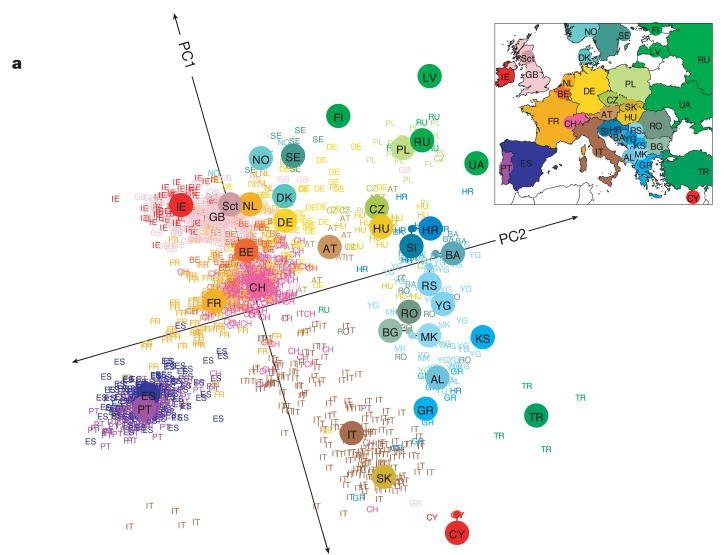
cautionary tale — genes mirror geography

197K SNPs, 1,387 Europeans

no geographic info given to the algorithm

→ it drew a map of Europe   (r^2 \approx 0.7)

. . .

→ math result: PCA on spatial data with distance-decaying similarity generically produces these patterns

→ recovering an obvious pattern is not evidence of hidden structure

Novembre 2008; Novembre & Stephens 2008

PCA or pick five?

instead of computing principal components, could we just pick the five best stocks and form a portfolio from them?

when would PCA be the right move? when would a sparse subset (Lasso) be the right move?

discuss with your neighbor (3 min).

demo: PCA in the notebook

colab.research.google.com/…/lec14-pca.ipynb

what to watch:

  • toggle standardization on/off — watch PC1 flip from “TSLA-dominated” to “market”
  • vary k from 1 to 20 — watch held-out variance drop, flatten, rise
  • swap in your own time window — does CV’s pick of k change?

summary

  • PCA finds the directions of maximum variance — best line, best plane, best k-dim subspace
  • standardize first — otherwise the largest-magnitude features dominate
  • PC1, PC2, PC3 on the S&P 100 are the market, cyclical-vs-defensive, growth-vs-yield
  • truncated SVD is what PCA computes (Eckart–Young–Mirsky: best rank-k approximation)
  • factor-model covariance \hat\Sigma_k = V_k \Lambda_k V_k^T + \text{diag} unlocks portfolios when p > n
  • interpretability is not validation — pick k by held-out task, not the scree elbow

next: clustering — same template, different constraint

PCA compresses each row into continuous coordinates in a k-dim subspace

K-means compresses each row into one of k discrete labels

same compress-into-k idea, different geometry

→ Monday: K-means on Airbnb (and the same “your features pick your structure” lesson, on a different method)

feedback

what worked? what didn’t? what’s still confusing?