MSE 125 — Applied Statistics
Monday, April 13, 2026
how much is a bathroom worth?
an Airbnb host is adding a second bathroom
how much more should they charge per night?
chapter 4’s model doesn’t know bathrooms exist
multiple regression with numeric features
chapter 4: \(\widehat{\text{price}} = 57 + 66 \times \text{bedrooms}\)
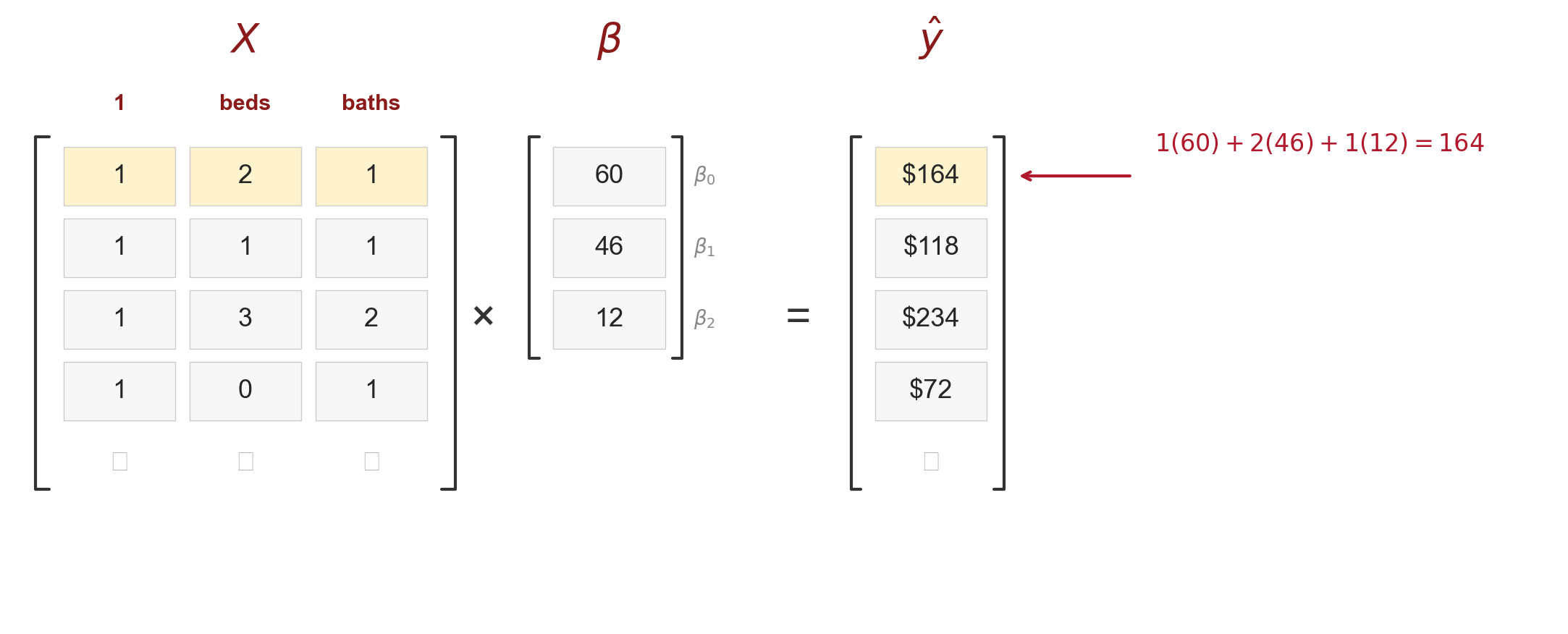
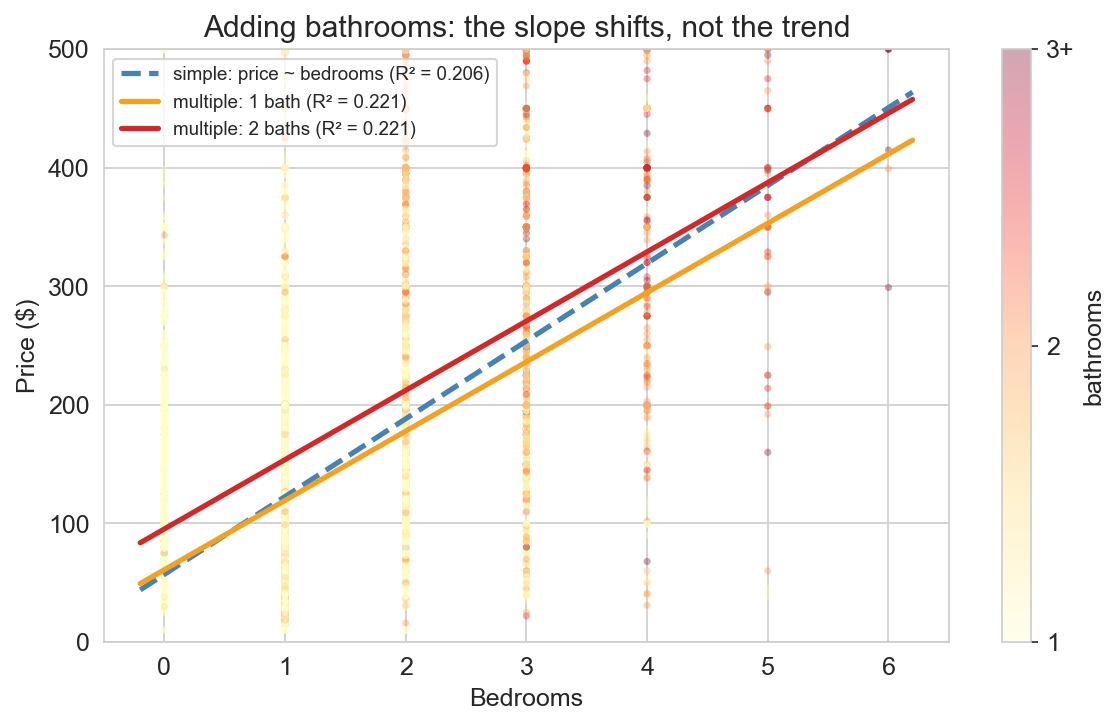
add bathrooms:
\[\widehat{\text{price}} = 27 + 58 \times \text{bedrooms} + 34 \times \text{bathrooms}\]
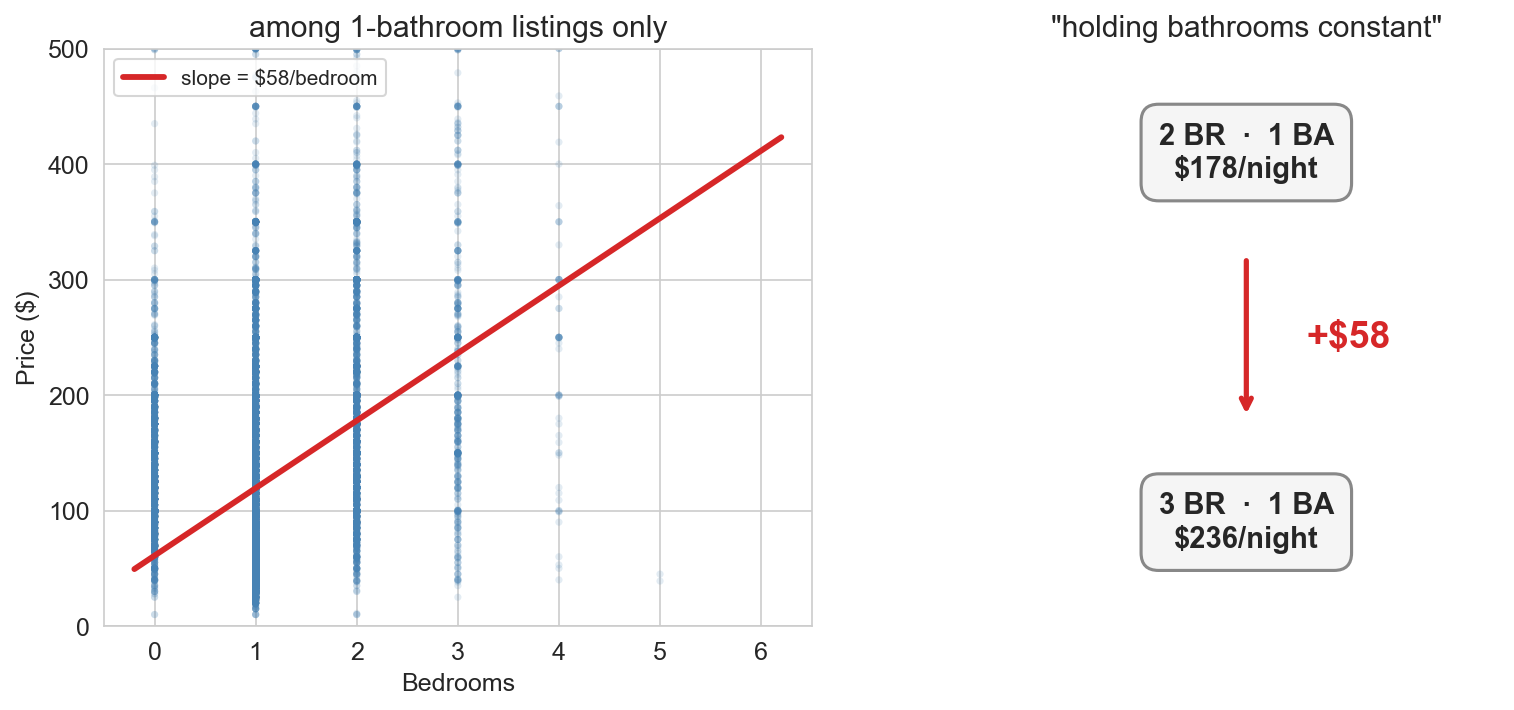
a 2BR / 1BA listing: \(27 + 58(2) + 34(1) = \$177\)
a 2BR / 2BA listing: \(27 + 58(2) + 34(2) = \$211\)
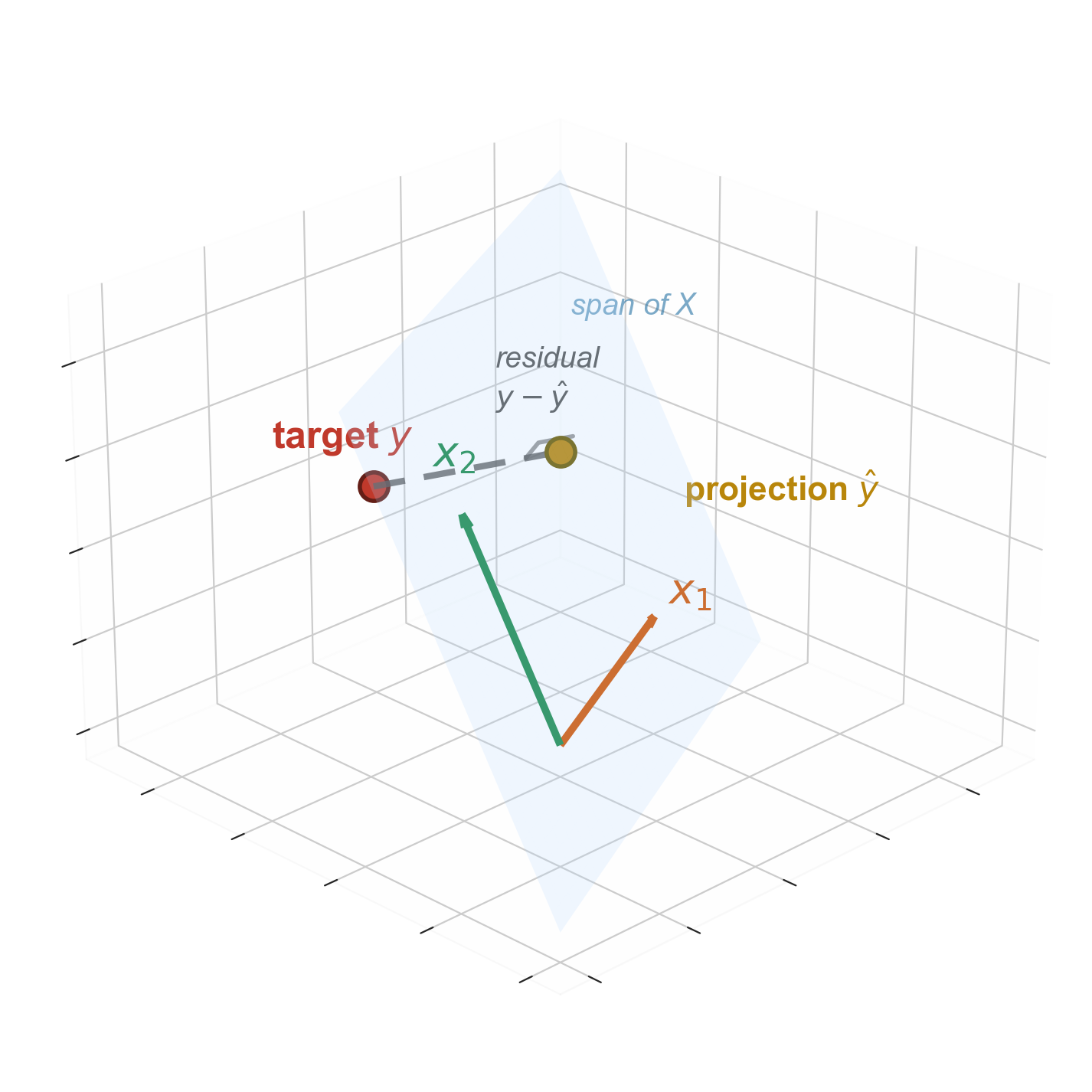
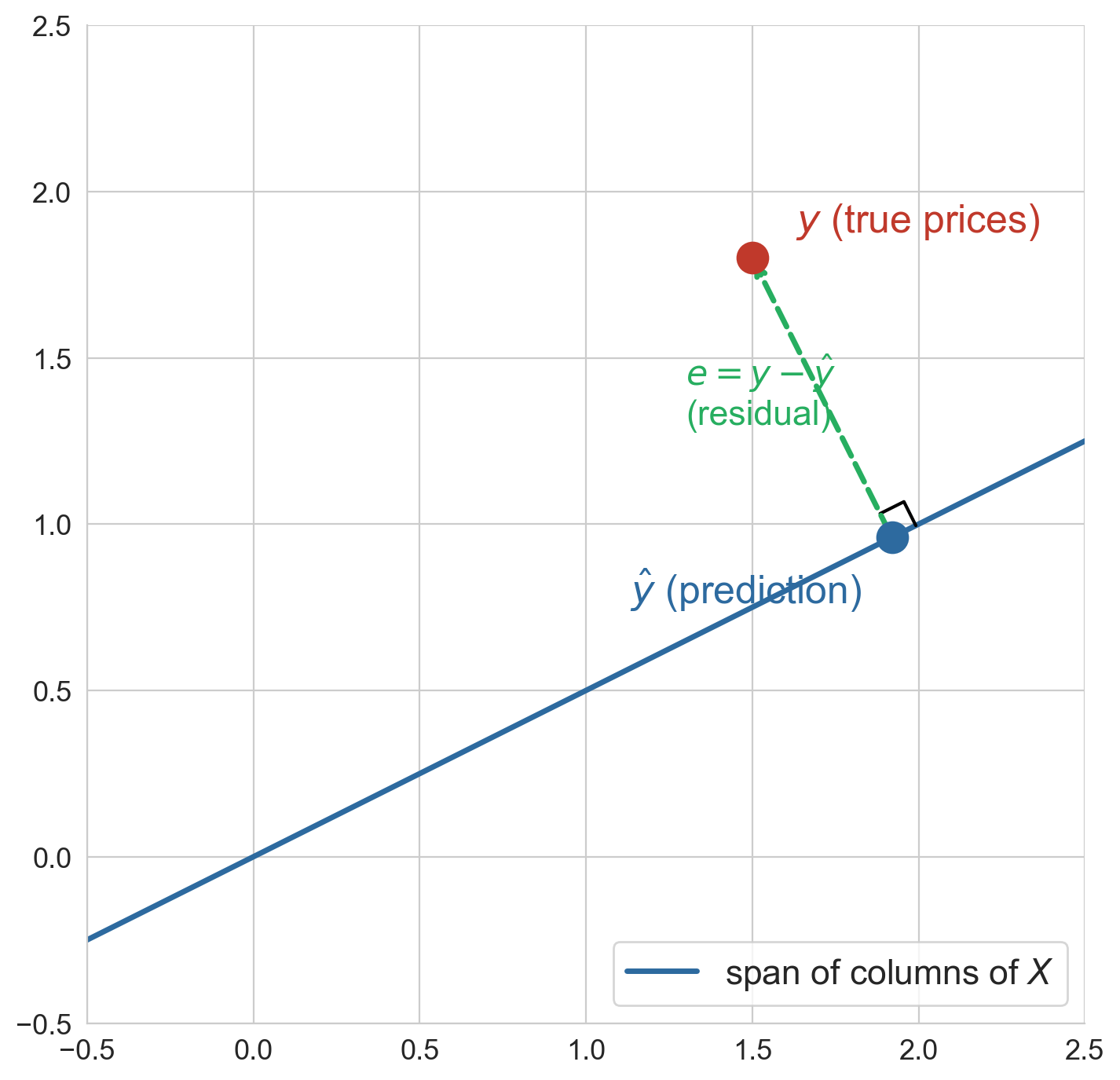
\[\text{span}(X) = \{X\beta : \beta \in \mathbb{R}^p\}\]
the set of all possible predictions · the span of the columns of \(X\)

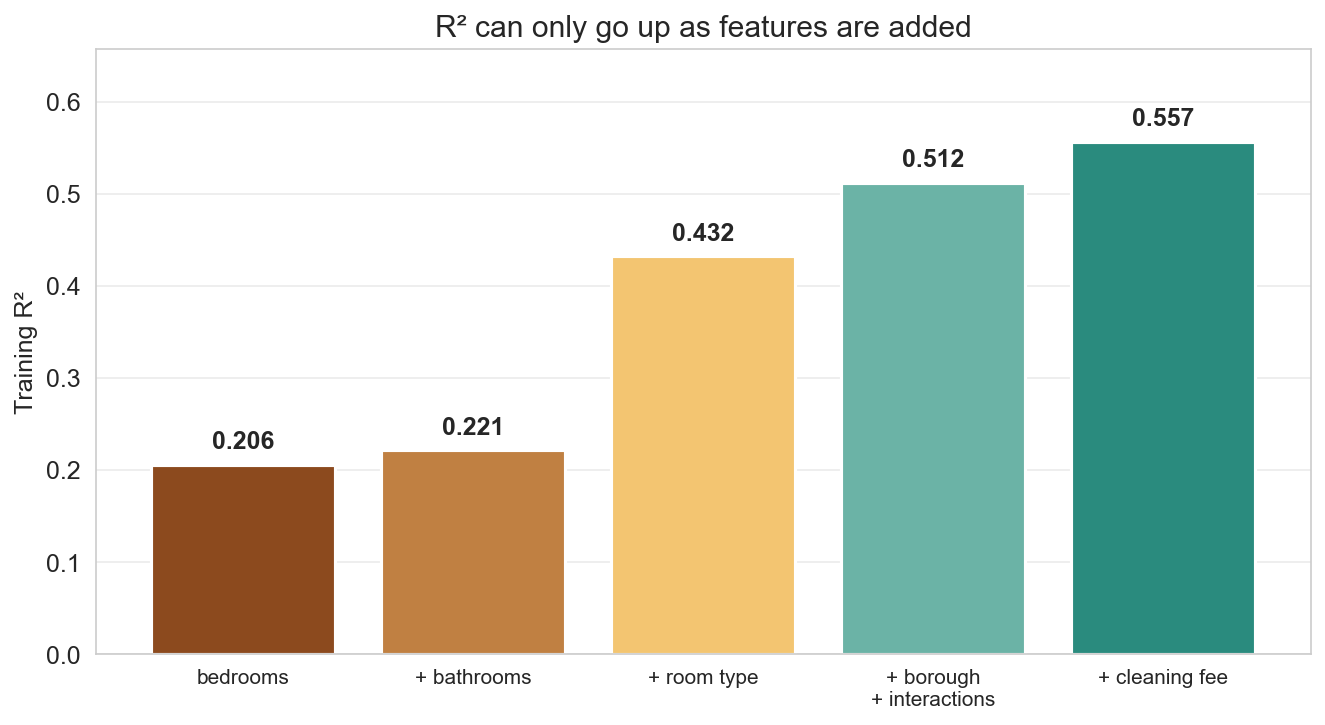
adding a feature never decreases training \(R^2\)
danger: \(R^2\) rewards you for adding noise
residual orthogonal to every feature column:
\[X^T \epsilon = 0 \quad \text{where } \epsilon = y - X\beta\]
rearrange:
\[X^T X \beta = X^T y\]
\[\widehat{\beta} = (X^T X)^{-1} X^T y\]
closed-form solution for the least-squares coefficients
[26.66 58.42 34.38]
np.linalg.solve(A, b) — don’t invert; factor and solveLinearRegression().fit(...) exactly\[\widehat{\text{price}} = 27 + \mathbf{58} \times \text{bedrooms}\] \[+ \; 34 \times \text{bathrooms}\]
coefficient = association holding bathrooms constant
| model | bedrooms coef |
|---|---|
| bedrooms only | $66 |
| + bathrooms | $58 |
bathrooms coefficient: $34
the bedrooms coefficient dropped $8 — why?
why did the bedrooms coefficient drop from $66 to $58 when we added bathrooms?
if stuck: think about what a 3-bedroom apartment usually has
simple regression on bedrooms alone absorbed part of the bathrooms signal
multiple regression disentangles them by holding each constant
these coefficients measure association, not causation
the word for this: confounding (→ Ch 18)
how do you put a string into a matrix?
you cannot multiply “Entire home/apt” by \(\beta\)
regression needs numbers
how would you convert room type to numbers for regression?
if stuck: what about entire home = 2, private room = 1, shared room = 0?
one binary (0/1) column per category
| entire home | private room | shared room |
|---|---|---|
| 1 | 0 | 0 |
| 0 | 1 | 0 |
| 1 | 0 | 0 |
| 0 | 0 | 1 |
each row has exactly one 1 — the category it belongs to
three dummy columns sum to the all-ones vector
but the intercept column is the all-ones vector
Reference level
drop one category; its baseline is absorbed into the intercept. every other coefficient measures a difference from the reference.
Q: if we dropped “Shared room” instead, which coefficients would change?
A: all of them — the baseline shifts
Intercept (Entire home/apt baseline): $186
room_type_Private room: −$108
room_type_Shared room: −$129
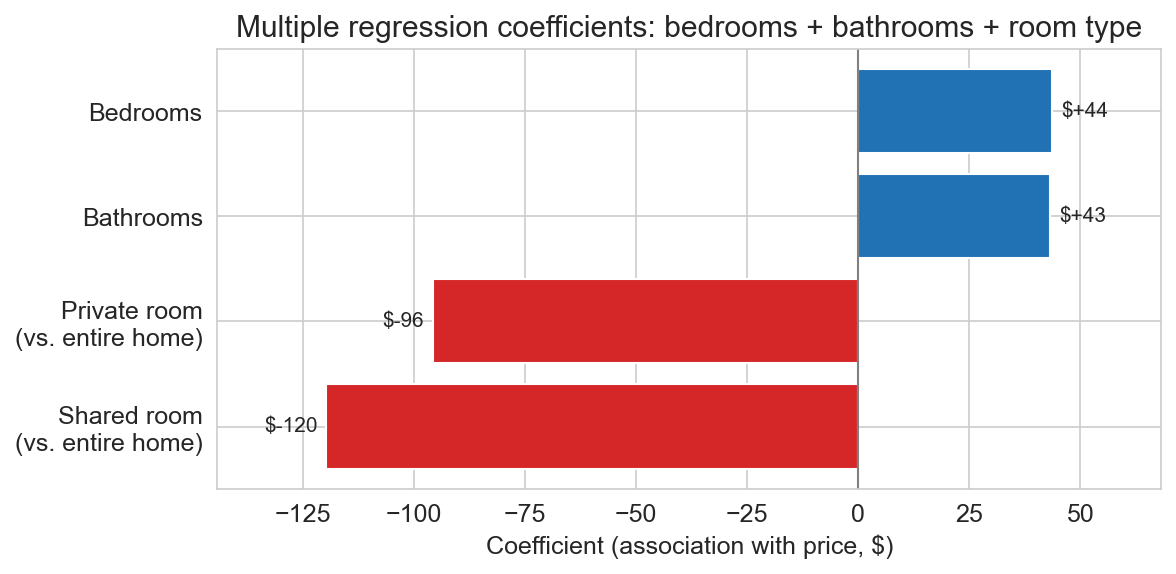
price ~ bedrooms + bathrooms + room type
Intercept: $80.79
bedrooms: +$43.67
bathrooms: +$43.13
room_type_Private room: −$95.77
room_type_Shared room: −$119.77
R² = 0.432
about $43 more per night
holding bedrooms and room type constant
negative bars = discounts from the entire-home baseline · intercept = $81 (the entire-home baseline)
Q: compute the predicted price of a private room, 2 bedrooms, 1 bathroom
\(81 + 44(2) + 43(1) - 96 = \$116\)
linear in parameters, not in features
every model we’ve fit: \(\widehat{y} = X\beta\)
the columns of \(X\) can be anything we compute from the raw data
is an extra bedroom associated with the same price change in Manhattan and the Bronx?
\[\widehat{y} = \beta_0 + \beta_1 \text{beds} + \beta_2 \mathbf{1}_{\text{Manh}} + \beta_3 (\text{beds} \times \mathbf{1}_{\text{Manh}})\]
where \(\mathbf{1}_{\text{Manh}} = 1\) if Manhattan, \(0\) otherwise
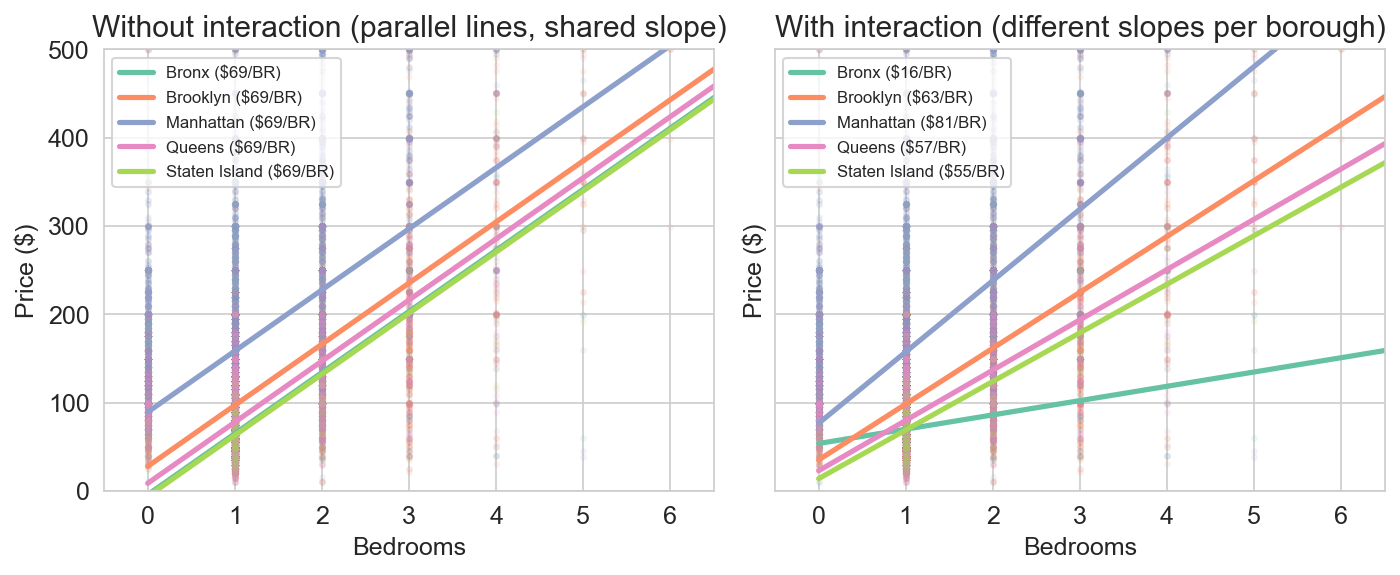
left: without \(\beta_3\) — parallel lines · right: with \(\beta_3\) — slopes differ by borough
| borough | $/bedroom |
|---|---|
| Manhattan | $81 |
| Brooklyn | $63 |
| Queens | $57 |
| Staten Island | $55 |
| Bronx | $16 |
a bedroom in Manhattan is associated with ~5× more than a bedroom in the Bronx
fee_missing flags imputed rowsQ: does the indicator column add anything beyond the imputed fee?
baseline (no fee): R² = 0.4322
+ imputed cleaning fee: R² = 0.4845
+ imputed fee + fee_missing: R² = 0.4982
cleaning_fee_imputed: $0.80 per $1 of fee
fee_missing: +$35.71
a blank fee carries its own price signal — missingness is information
dollars vary · percentages cluster
| borough | $/bedroom | % per bedroom |
|---|---|---|
| Manhattan | $81 | 51% |
| Brooklyn | $63 | 64% |
| Queens | $57 | 71% |
| Staten Island | $55 | 80% |
| Bronx | $16 | 23% |
four of five boroughs cluster 51–80% per bedroom · Bronx is the outlier
if one shared percentage replaces five dollar slopes, one coefficient does the work of five
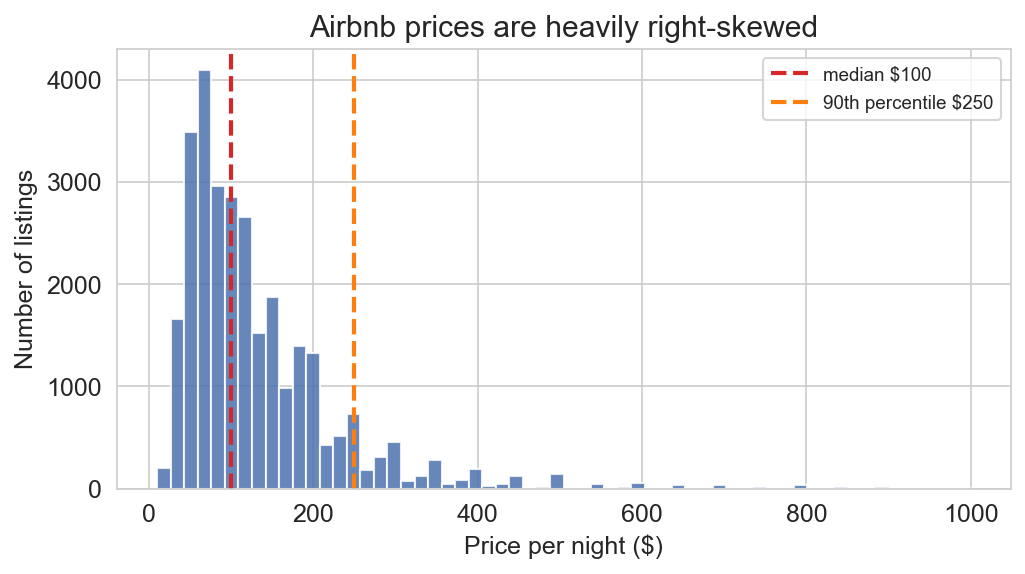
median $100 · 90th percentile $250 · tail runs to $999
the top 5% of listings hold nearly half the level model’s squared error
a $50 miss on $100 (50% off) ≡ a $50 miss on $500 (10% off) — squared dollars can’t tell them apart
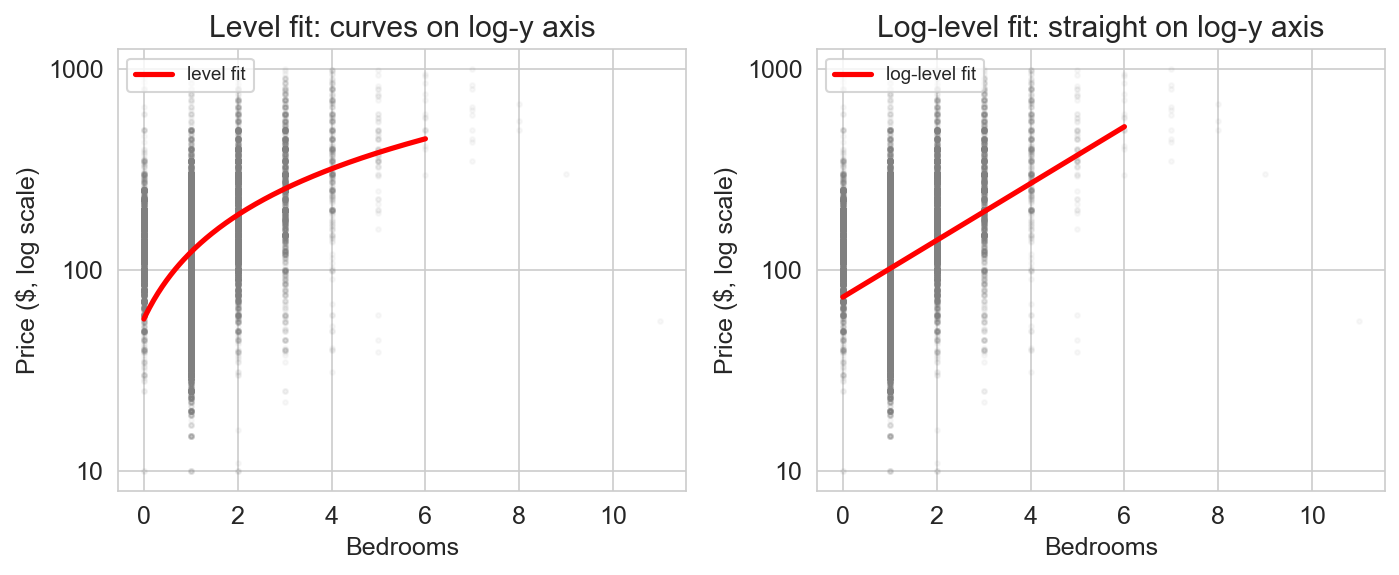
linear model: each bedroom adds a fixed dollar amount
prices grow multiplicatively, not additively
ax.set_yscale('log') — log y-axis, same data. level fit curves; log-level fit is straight.
\[e^{0.33} \approx 1.38\]
each bedroom multiplies price by ~1.38 — about 38% more per bedroom
log model with borough: shared multiplier per bedroom is about 1.42 (about 42%)
apply that multiplier to each borough’s base:
| borough | $/bedroom (0→1) |
|---|---|
| Manhattan | $39 |
| Brooklyn | $25 |
| Queens | $21 |
| Staten Island | $19 |
| Bronx | $18 |
same proportional jump · bigger base → bigger dollars
honest limit: the Bronx is an outlier we accept — the price of simplification
\[y \sim \log(x) \quad\Longrightarrow\quad \text{a **1% increase** in } x \text{ adds about } \tfrac{\beta_1}{100} \text{ to } y\]
use it when \(x\) ranges over orders of magnitude:
a unit change in income means something totally different at the bottom and top — a percentage change is the natural unit
Elasticity
when both \(y\) and \(x\) are on the log scale, \(\beta_1\) is the percentage change in \(y\) from a 1% change in \(x\).
\[\log(\text{price}) \sim \log(\text{accommodates}) \quad\Longrightarrow\quad \beta_1 \approx 0.66\]
a 10% larger listing is associated with about 6.6% more price
elasticities are dimensionless — compare effects across features on wildly different scales
| model | \(\beta_1\) means | example |
|---|---|---|
| \(y \sim x\) | unit change in \(x\) → \(\beta_1\) change in \(y\) | each bed adds $66 |
| \(\log y \sim x\) | unit change in \(x\) → multiply \(y\) by \(e^{\beta_1}\) | each bed × 1.38 |
| \(y \sim \log x\) | 1% change in \(x\) → \(\beta_1/100\) change in \(y\) | 10% sqft → $5 more |
| \(\log y \sim \log x\) | 1% change in \(x\) → \(\beta_1\)% change in \(y\) | elasticity (e.g. 0.66) |
when should the response be on a log scale?
for which of these would you use log(y)?
diagnostics: how you catch your own mistakes
training \(R^2\) never decreases with more features — even random noise
penalize for the number of features:
\[R^2_{\text{adj}} = 1 - \frac{(1 - R^2)(n - 1)}{n - p - 1}\]
where \(n\) = sample size, \(p\) = number of features
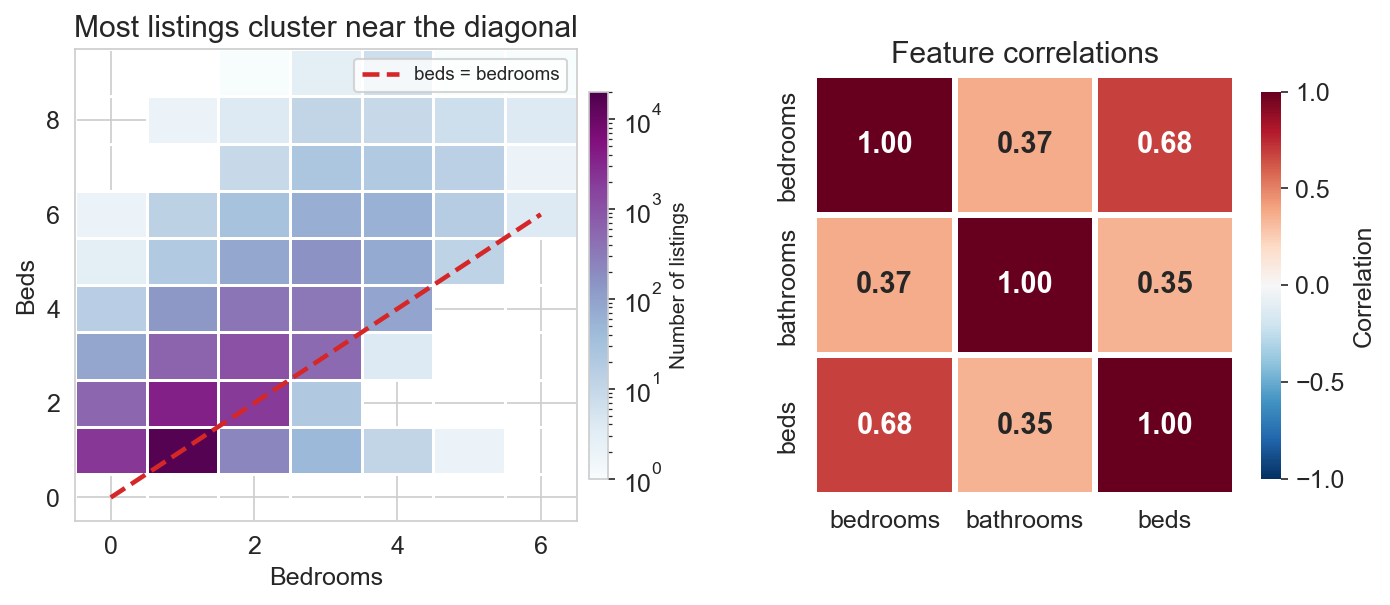
beds and bedrooms are nearly the same feature · correlation ≈ 0.68
| without beds | with beds | |
|---|---|---|
| bedrooms | +58.43 | +28.48 |
| bathrooms | +34.37 | +25.52 |
| beds | — | +30.98 |
| \(R^2\) | 0.2215 | 0.2755 |
bedrooms coefficient cut in half from $58 to $28 — beds absorbed the signal
predictions may still be fine — individual coefficients become uninterpretable
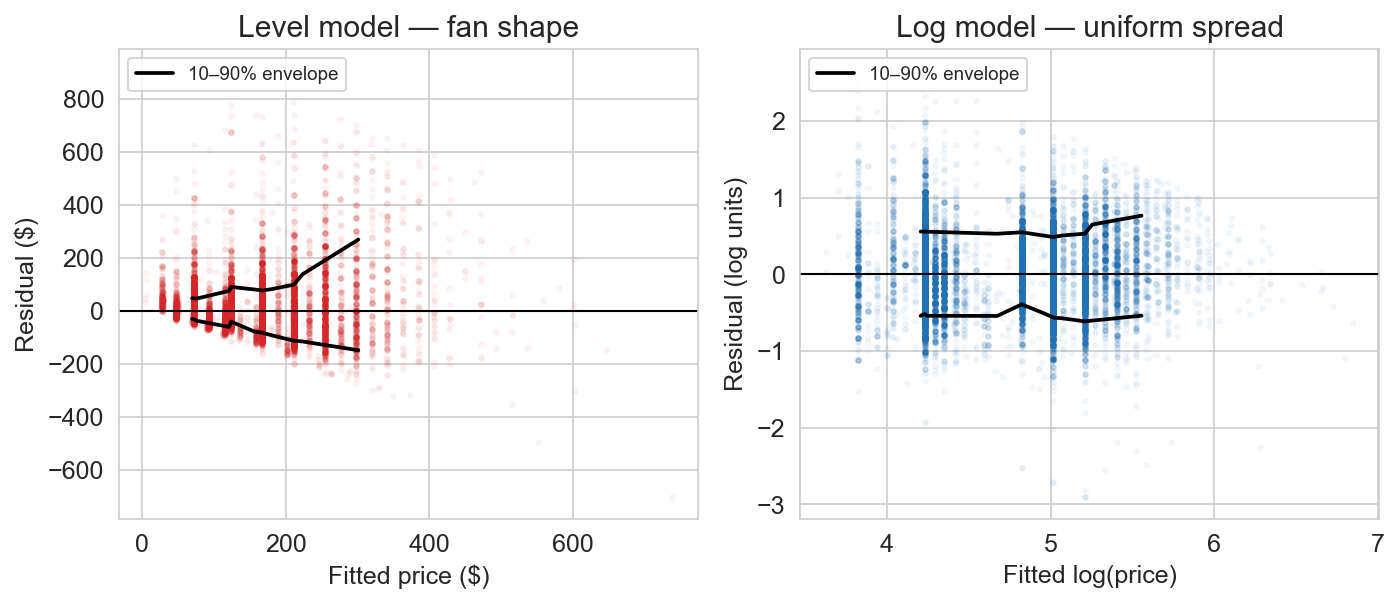
residual = observed − predicted: \(\epsilon_i = y_i - \hat{y}_i\)
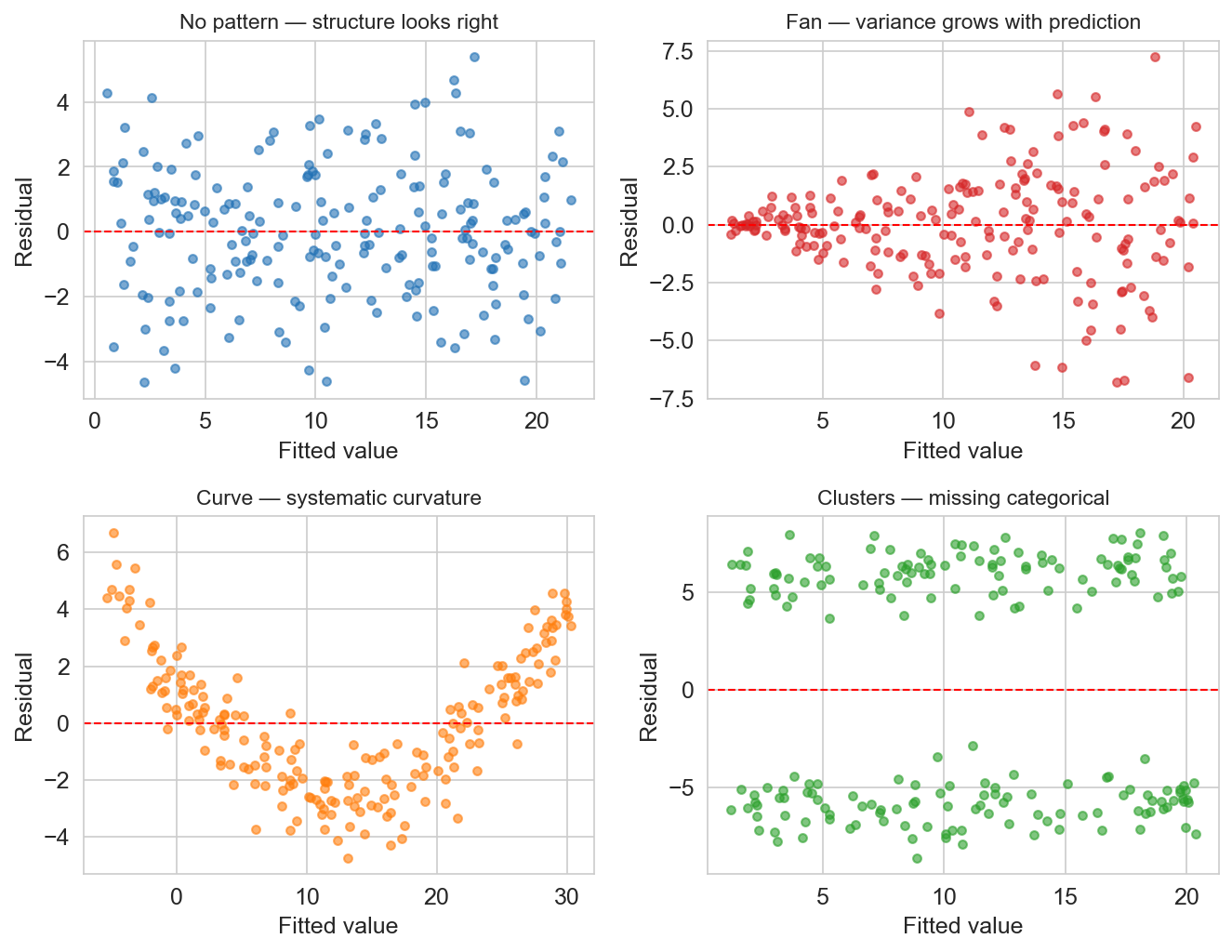
level model: fan from our vocabulary · spread grows with predicted price
log model: flat band · the fan is gone
what would you do next?
given the fan in the level-model residuals — fit the log model, or stay with level?
we can fit models. next: how to trust them.